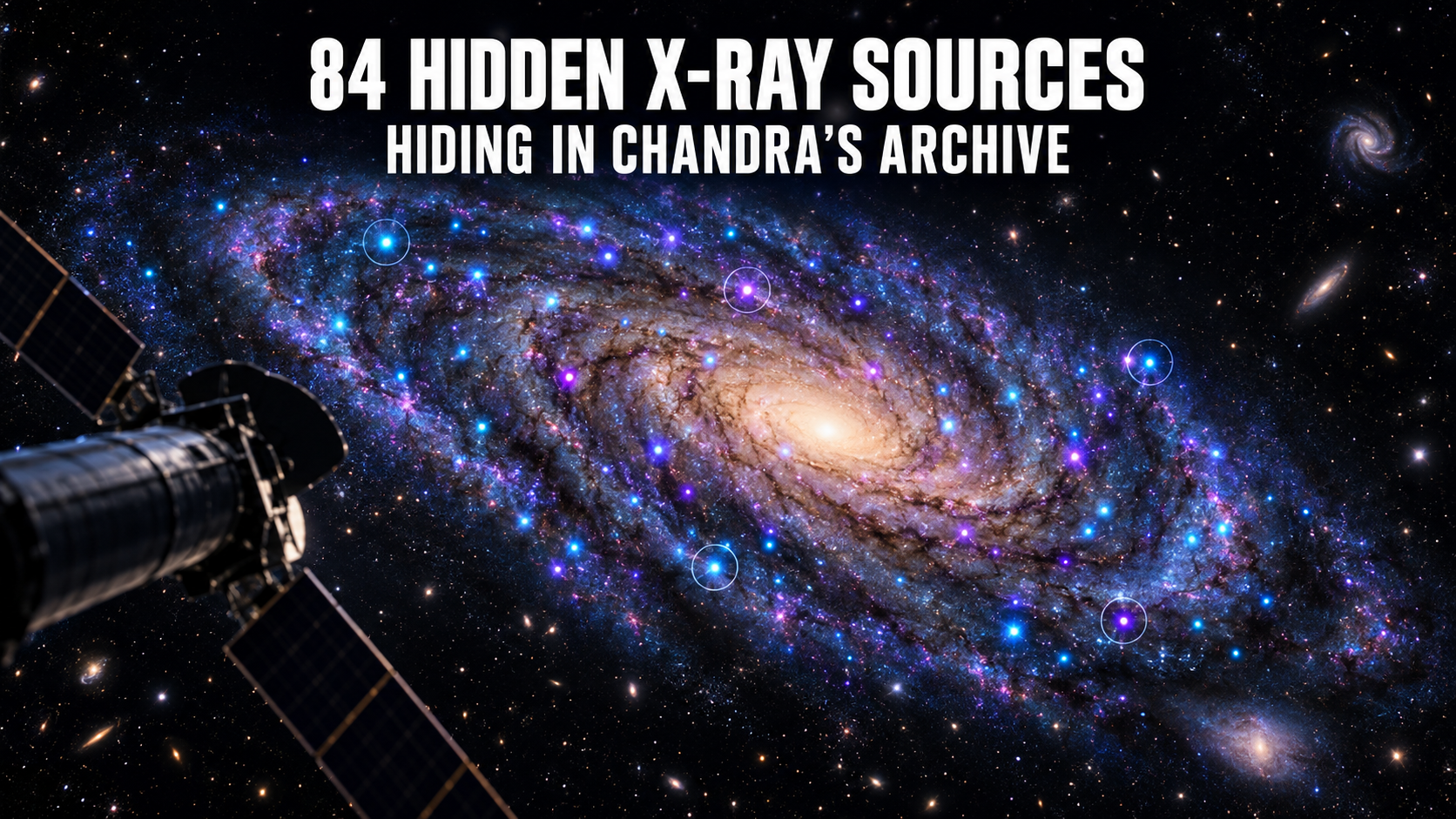
Chandra archival data revealed 84 hypersoft X-ray sources that may help astronomers identify hidden stellar systems and possible Type Ia supernova progenitors.
They were bright enough to rival some of the most energetic objects in nearby galaxies.
Yet astronomers had largely missed them.
A new study of archived data from NASA’s Chandra X-ray Observatory has identified 84 unusual objects in six galaxies. Researchers call them hypersoft X-ray sources, or HSSs.
They may contain white dwarfs, neutron stars or black holes pulling material from companion stars. But their exact identities remain uncertain.
More puzzling is how such powerful objects stayed hidden for so long.
What Chandra Actually Found
The 84 sources were detected in six nearby galaxies, including:
- M31, the Andromeda Galaxy
- M101, the Pinwheel Galaxy
- Four elliptical galaxies
They appeared in regions containing young stars as well as areas dominated by older stellar populations.
That means they are probably not one rare object confined to a particular type of galaxy.
The 2026 Nature Astronomy study describes them as bright, point-like sources located away from galactic centers. They appeared mainly at X-ray energies below 0.3 keV and became faint or vanished at higher energies.
That unusual pattern earned them the name “hypersoft.”
Hypersoft Does Not Mean Weak
Most X-ray binaries produce stronger, higher-energy X-rays.
They form when a dense stellar remnant pulls gas from a nearby companion. The stolen material becomes extremely hot as it falls toward a black hole, neutron star or white dwarf.
The new sources appear cooler than typical X-ray binaries—but they are not faint.
Some may release hundreds of thousands or even millions of times more energy than the Sun. The catch is that much of this energy may emerge as extreme-ultraviolet light rather than easily detectable X-rays.
Chandra may therefore be seeing only a small part of their total output.
Why Were They So Difficult to See?
Extreme-ultraviolet light falls between ultraviolet radiation and low-energy X-rays.
Unfortunately, neutral hydrogen and helium absorb it extremely well. Much of the EUV light produced in distant galaxies never reaches our telescopes.
Low-energy X-rays are also easily absorbed, and X-ray instruments become less sensitive near the lowest end of their detection range.
The objects were effectively hidden behind two barriers:
- Their strongest radiation was absorbed before reaching us.
- The X-rays that escaped fell near the edge of Chandra’s sensitivity.
Researchers found them by searching old Chandra observations for sources that appeared in the lowest-energy images but disappeared when the energy range increased.
The telescope had already collected the clues. Astronomers simply needed a different way to examine them.
What Could These Objects Be?
There may not be one answer for all 84 sources.
Accreting white dwarfs
Several less luminous sources in Andromeda are associated with novae. These occur when a white dwarf collects material from a companion star and triggers a thermonuclear eruption.
Some HSSs may therefore be white dwarfs undergoing surface burning or recovering after nova explosions.
Hidden black holes
The brightest sources could involve black holes consuming matter in an unusual state. Their accretion regions may shift much of the energy toward ultraviolet and low-energy X-rays.
This possibility is not confirmed. The current data reveal how the sources radiate, not what lies at their centers.
Andromeda has produced other difficult cases involving possible black holes. The earlier article M31-2014-DS1: Black Hole Birth or a Star Hidden by Dust? examines a massive star that faded by more than 10,000 times without a normal supernova.
M31-2014-DS1: Black Hole Birth or a Star Hidden by Dust?
M31-2014-DS1 faded by more than 10,000 times, but did it form a black hole or survive behind dust? Two studies read the evidence differently.A massive star in the Andromeda Galaxy became more than 10,000 times fainter in visible light. It did not produce t
spaceunknown.tistory.com
Neutron stars
A neutron star pulling material from a companion could also produce unusual thermal radiation. Researchers have not ruled out this explanation.
For now, “hypersoft X-ray source” describes what astronomers observe—not necessarily one type of object.
Could They Be Stars Waiting to Explode?
Some accreting white dwarfs may eventually become Type Ia supernovae.
These explosions are important because astronomers use their predictable brightness to measure cosmic distances. They helped reveal that the expansion of the universe is accelerating.
But a major question remains: what kinds of stellar systems actually produce all Type Ia supernovae?
If some hypersoft sources are growing white dwarfs, astronomers may be seeing a previously hidden stage before an explosion.
That does not mean all 84 objects are future supernovae. It gives researchers a new group of candidates to monitor.
A Second Mystery They May Help Solve
The sources might also explain how gas between stars becomes ionized.
Massive stars produce ultraviolet radiation that strips electrons from hydrogen. But in some galaxies, known stars do not appear to provide enough energy to explain all the ionized helium and heavier elements.
A hidden population of powerful EUV sources could supply some of the missing radiation.
If so, these objects may influence:
- How interstellar gas heats and cools
- How quickly new stars form
- How galaxies change over time
Small points in a Chandra image could therefore affect entire galactic environments.
What We Still Do Not Know
Chandra has not discovered 84 confirmed black holes or 84 stars about to explode.
The more accurate conclusion is this:
- Astronomers have recognized a previously overlooked population.
- Several types of compact stellar systems could be involved.
- Additional observations are needed to identify individual sources.
- Their hidden ultraviolet energy may solve two long-standing cosmic questions.
What interests me most is where the discovery was made.
The evidence was not found during a new journey into space. It was waiting inside an existing archive.
Sometimes the universe does not need to send us a new signal. We need to learn how to notice the signal we already have.
'NASA & Space Science' 카테고리의 다른 글
| Curiosity Found 1-Centimeter “Footprints” on Mars—What Made Them? (0) | 2026.09.17 |
|---|---|
| Elias 2-24 b: Why the Youngest Known Planet Grew So Fast (0) | 2026.09.17 |
| Oxygen on an Exoplanet? Why It Would Not Prove Alien Life (0) | 2026.09.14 |
| Mars or K2-18b: Which Alien-Life Evidence Did Scientists Trust More? (0) | 2026.09.14 |
| Saturn’s South Pole Has a Giant Decagon—Why Now? (0) | 2026.09.03 |


